
Full Flat Roof Replacement on a Two‑Storey Home in Whitchurch‑Stouffville
Two‑storey home with an ageing rubber roof, leaking edges and limited ladder access — we stripped and rebuilt to modern standards.
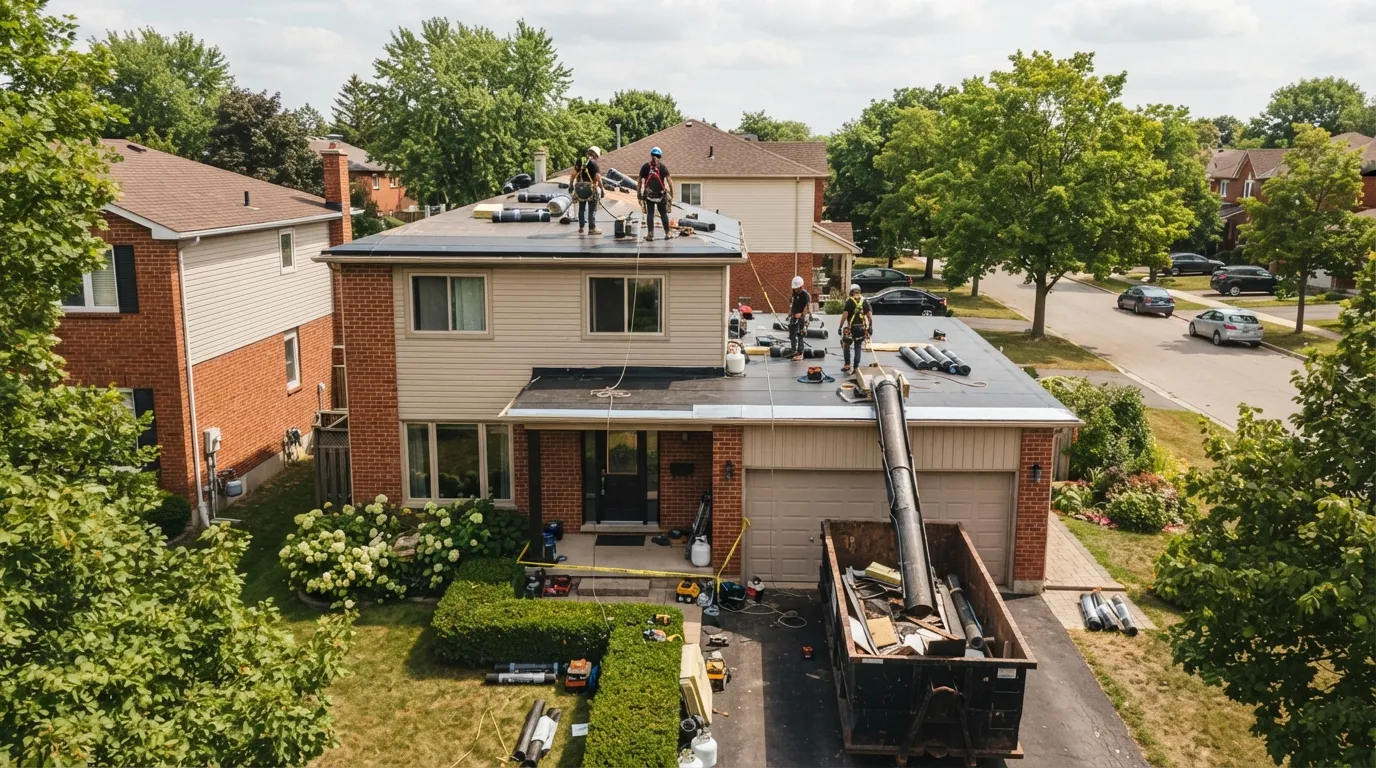
What we walked into
This was a two‑storey house in Whitchurch‑Stouffville with a low‑slope flat section over an addition. The existing membrane had reached end of life and was shedding water at several seams. The homeowner wanted a dependable, low‑maintenance solution that met York Region code guidance and reduced the risk of winter ice problems.
Worn membrane and ponding
The EPDM showed splitting at terminations and multiple soft spots where ponding had formed. Left unattended, the water entry points had already discoloured ceiling finishes inside.
Tight access and staging
The house sits on a deep lot with hedges and a rear deck that limited crane or large lift placement. That meant we planned for hand‑carried materials, scaffolding and temporary protection for shrubs and decking.
Homeowner wanted low maintenance
They asked for a robust system that handles heavy Ontario winters in York Region and reduces future service calls. They also wanted clear documentation for insurance and any future sale.
How we did it — step by step
- 1
1. Inspect, document and scope the work
We started with a roof assessment from the ladder and via infrared where needed to confirm no hidden wet insulation. We photographed penetrations, flashings and the roof deck before quoting, so the homeowner knew exactly what would be replaced.
- 2
2. Remove old membrane and check deck
We stripped the EPDM back to the plywood deck. Damaged plywood was replaced with exterior‑grade 19mm plywood installed to a staggered seam pattern. This ensures a solid substrate before installing a new membrane.
- 3
3. Install insulating and drainage stack
We laid a tapered polyiso insulation system to create positive drainage to scuppers and internal drains — important in Whitchurch‑Stouffville to avoid winter freeze‑thaw ponding. Insulation joints were staggered and mechanically fastened per manufacturer specifications to the roof deck.
- 4
4. Apply a long‑life membrane and flashings
We used a torch‑applied modified bitumen membrane for durability and heat resistance at terminations, with hot‑applied flashings at parapets and metal copings. All penetration boots were upgraded to vulcanized EPDM collars where required and sealed with manufacturer‑approved primers and adhesives.
- 5
5. Finish details and site restore
We fitted new aluminium drip edges and painted metal flashings with an exterior coating suitable for York Region climates. Gutters and downspouts were reconnected, debris cleared, and we walked the homeowner through maintenance points and warranty paperwork.
What the homeowner got
The finished roof behaves like a roof should: dry, well‑drained and ready for Ontario weather. We left clear records and made sure the details were built to last.
Improved performance and drainage
Tapered polyiso and new scuppers eliminated the ponding areas. With a mechanically fastened assembly and proper flashings, the risk of seam leaks is dramatically reduced.
Durability for our climate
Modified bitumen and properly detailed metal flashings stand up to freezing cycles, salt on nearby roads and UV exposure. The insulation profile also helps limit thermal movement that can stress membranes.
Paperwork and warranty clarity
We provided a detailed job report, photos and manufacturer warranty information for materials and workmanship. That paperwork helps with insurance records and gives the homeowner confidence when putting the house on the market.
Common questions about flat roof replacements
How long does a full flat roof replacement take?
Typical timelines run from several days to about two weeks depending on the size, the need for deck repairs and weather. In Whitchurch‑Stouffville we factor spring thaw and winter freezes into scheduling to avoid delayed adhesives or torch work.
How disruptive is the work to the household?
Expect noise from tear‑off and cutting and workers on site during business hours, but most interior disruption is minimal. We protect entries, stage materials off the lawn where possible, and keep work areas tidy every day.
When is a flat roof replacement necessary versus a repair?
If you have multiple soft spots, recurring leaks at different locations, or the membrane is beyond manufacturer life, replacement is usually the smarter long‑term choice. Local York Region weather accelerates ageing, so repeated repairs are often a sign replacement will pay off.
Are there code or permit issues I need to know about?
Permits and local code requirements vary across York Region; we always check municipal regulations for Whitchurch‑Stouffville and coordinate any necessary permit applications. We build to current fire and ventilation guidance and follow manufacturer fastening patterns to meet code and warranty needs.